
Xi'an Xu&Hui Electromechanical Technology Co., Ltd.
Xi'an Xu&Hui Electromechanical Technology Co., Ltd.
- China
- Verified Supplier
Sản phẩm
TDR Cable Fault Locator
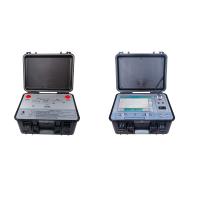
TDR Underground Cable Fault Pre Locator Multiple Pulse Test Cable Fault Distance
-
Category: TDR Cable Fault Locator
-
Status: Available
-
ID: 1
Product Specification
| Atmospheric pressure | 750±30mmHg | Packaging Details | Wooden case |
| Test blind spot | ≤20m | Ranging range | ≥68km |
| Supply Ability | 500units/month | Sampling frequency | 400MHz |
| Payment Terms | T/T | Delivery Time | 5-8 work days |
| Working conditions | temperature -25℃~+65℃, relative humidity 85% | Minimum resolution | 0.5m(100m/us) |
| Low voltage pulse width | 0.2uS/2uS/4uS | Measurement error | ≤±(0.5%×L+1m),L is the cable length |
| Place of Origin | Xi'an, Shaanxi, China | Model Number | XHGG502 |
| Certification | CE | Brand Name | XZH TEST |
XHGG502
XHGG502 Cable Fault Pre Locator is a special instrument for measuring and analyzing power cable status and fault distance. It combines modern electronic technology and computer technology to realize signal filtering, acquisition, data processing, graphic display and graphic analysis to complete cable speed measurement, cable Length test, cable fault distance test.
This cable fault locator adopts 12.1-inch industrial-grade computer control, windows operating system, touch operation mode, ultra-high brightness, large LCD screen display interface for user-friendly use, automatic continuous sampling, and real-time accurate waveform acquisition.
The XHGG502 ARC cable fault pre locator adopts the latest technology of embedded industrial computer and the most advanced "eight pulse method" (multiple pulse method) testing technology, so that any high-resistance fault presents the simplest short-circuit fault waveform similar to low-voltage pulse Features are easy to read. It also has the operation modes of shock high voltage flashover method and low voltage pulse method, which is convenient to detect various cable faults. The success rate of fault detection, test accuracy and test convenience are better than any domestic testing equipment.
Main features
• The reflected signal sent by the pulse coupler is automatically displayed, and the full-length waveform of the cable open circuit is displayed at the same time.
• Automatic calculation and display of fault distance;
• It has the function of storing massive test waveforms: the waveforms obtained from the field test can be conveniently stored in the instrument according to the specified order, and can be recalled and observed at any time;
• With standard printer USB interface;
• Simple operation and high reliability. Has a very high cost performance;
• Built-in polymer lithium battery power supply, which can test cable open circuit and low resistance short circuit fault in no power supply environment.
The test working modes of XHGG502 ARC cable fault pre locator include low voltage pulse method, high voltage flashover method, and multiple pulse method. Here focus on the multiple pulse method that is different from other devices.
The purpose of using the multiple pulse method to test the cable fault is to make the sent low-voltage test pulse effectively avoid the cosine large oscillation interference that occurs at the moment of the high-voltage impact of the faulty cable, and obtain a standard and clear similar short-circuit during the relatively stable short-circuit arc at the fault point. The echo of the fault, and there is a large choice of ideal test waveforms.
Different impulse high voltages, different cable lengths, different cable fault distances, and the period and duration of large cosine oscillations are very different. The waveform collected by the simple secondary pulse method is often disturbed by the large cosine oscillation due to insufficient transmission delay time, and the waveform is chaotic and difficult to analyze. It can only be ensured by adjusting the delayed launch time of the test pulse or using a medium-voltage arc-extending device, which increases the difficulty of operation and the weight and cost of the equipment. The multiple pulse method just overcomes these difficulties and greatly simplifies the testing procedures. Eight sets of test waveforms are obtained from the high-voltage flashover process of one impact, and there are always several sets of waveforms that are convenient for fault distance interpretation. This is also the advantage of the multiple pulse method compared with the second pulse method.
Operation system
The device has three test methods, namely, multiple pulse method, low voltage pulse method, and high voltage flashover method.
The low-voltage pulse method is suitable for testing low-resistance faults, the entire length of the cable or the open-circuit fault distance, and the short-circuit cable fault distance.
The high-voltage flashover method and multiple pulse method are suitable for testing the high-resistance cable fault distance.
Technical parameters
| Sampling frequency | 400MHz |
| Minimum resolution | 0.5m (100m/us) |
| Low voltage pulse width | 0.2uS/2uS/4uS |
| Test blind zone | ≤20m |
| Ranging range | ≥68km |
| Measurement error | ≤±(0.5%×L+1m), L is the cable length |
| There are three test cable lengths | <1km (short distance); <3km (medium distance); >3km (long distance), (low-voltage pulse test amplitude: 400Vpp) |
| Pulse coupler withstand voltage | DC 35kV |
| Measuring pulse | Low voltage pulse 300V±10% |
| Output impedance | 350 Ohm |
| Input signal gain | ±64dB |
| Power consumption | 120VA |
| propagation speed factor | 10-300m/μs |
| Working conditions | temperature -25℃~+65℃, relative humidity 85%, atmospheric pressure 750±30mmHg |

The device can collect 8 sets of cable information waveforms at a time, and select the best and easiest to analyze waveform for analysis.
Panel introduction

1 Display: 12.1-inch industrial-grade touch screen;
2 Communication: low-voltage pulse method pulse signal output interface, high-voltage flashover method sampler receiving signal input interface;
3 Grounding: safety grounding terminal;
4 Power indicator: Indicates the internal battery power, displayed in 4 grids;
5 USB-1: External wireless network card and USB communication device;
6 USB-2: External wireless network card and USB communication device;
7 Power switch: "I" position, use AC 220V power supply to supply power to the system;
The “II” gear uses the internal battery to power the system; when the “power socket” is connected to the AC 220V power supply, it also charges the battery at the same time;
"O" gear, turn off the system power;
8 Power socket: working power supply of the instrument, AC 220V connection port;
9 Fuse: the place where the fuse of the AC 220V power supply system is installed;
10 Self-check: transmit signals under multiple pulses;
11 On/Off: Turn on and off the working power of the industrial computer;
12 Amplitude: Adjust the amplitude knob when collecting waveforms to change the amplitude of the collected waveforms;
13 Indicator light: the indicator light reflecting the inspection method;
14 Displacement: Adjust the displacement knob when acquiring waveforms to change the baseline height of the acquired waveforms;
Packing list




Portable Automatic Test Long Cable ARC Multi Pulse Cable Fault Pre Locator
-
Category: TDR Cable Fault Locator
-
Status: Available
-
ID: 2
Product Specification
| Pulse width | 0.15uS/0.30uS/0.60uS/1.20uS/2.4uS/5.0uS/7.5uS/10uS | Packaging Details | Wooden case |
| Ranging range | ≥120km | Power supply | charging AC110V~240V, 50Hz/60Hz |
| Test blind area | ≤10m | Supply Ability | 500 units/month |
| Sampling frequency | 1MHz~400MHz | Payment Terms | T/T |
| Delivery Time | 5-8 work days | Minimum resolution | 0.07m |
| Low voltage pulse amplitude | 300V±15% | Measurement error | ≤±(0.5%×L+1m) |
| Place of Origin | Xi'an, Shaanxi | Model Number | XHGG502A |
| Certification | CE | Brand Name | XZH TEST |
XHGG502A
The cable fault pre locator XHGG502A adopts an industrial-grade 10.1-inch touch-integrated computer, a simple operating software interface, industrial-grade integrated circuits and devices, and a built-in large-capacity lithium-ion battery, which is stable, reliable, and easy to use.
This cable fault tester is a special instrument for measuring and analyzing the status and fault distance of power cables. It uses a combination of modern electronic technology and computer technology to achieve signal filtering, acquisition, data processing, graphic display, and graphic analysis. Cable speed measurement, cable length test, cable fault distance test.
This TDR is suitable for low-resistance, short-circuit, open-circuit and disconnection faults of power cables, high-frequency coaxial cables, street light cables, and buried wires made of various materials with different cross-sections and media, as well as high-resistance leakage and high-resistance flashover. Network failure. The technical parameters comply with "GB/T 18268.1 Anti-interference requirements for test equipment used in industrial sites", "DL ∕ T 849.1-2019 General technical conditions for special testers for power equipment Part 1: Cable fault flash tester", "JJF1042-2020" "Calibration Specifications for Cable Fault Testers" standard requirements.
Work mode: TDR(low voltage pulse), ICE(Impulse current), ARM(Arc reflection method) with coupler configured.
Features
• 10.1-inch full-color TFT touch display;
• Embedded system, safe, stable and simple display and operation mode;
• With the function of testing cable wave speed, cable length and fault distance;
• Fully automatic continuous sampling, waveform capture at all times, timely and accurate.
• Equipped with automatic test range setting, automatic waveform analysis and display of test distance.
• Full English menu, two operation methods of touch and coded buttons, simple, fast and reliable.
• Equipped with testing technology of low-voltage pulse method, high-voltage flashover method, and multiple pulse method (8 times), the waveform display is smooth and easy to interpret.
• When using the multiple pulse method, it is used with a pulse coupler to display 8 groups of high and low voltage waveform comparisons, which is convenient for automatic distance testing, manual analysis and distance measurement.
• The instrument has powerful data processing capabilities, making it convenient for users to manage and archive waveform files.
• Has a massive test waveform storage function: the waveforms tested on site can be conveniently stored in the instrument in the order specified by Chinese naming for recall and observation at any time; it can store more than 8,000 records of low-voltage pulses and high-voltage flashover waveforms, and multiple pulses More than 250 waveform records can be recorded, and waveform files can be imported into computer software for management and analysis using USB communication.
• Ultra-high brightness, LED backlight brightness reaches 280nit, resolution 1024*600, convenient for environments exposed to direct sunlight in operation.
Technical specification
| Sampling frequency | 1MHz~400MHz |
| Low voltage pulse amplitude | 300V±15% |
| Ranging range | ≥120km |
| Test range | 100m/300m/500m/1km/3km/5km/10km/25km/50km/100km |
| Pulse width | 0.15uS/0.30uS/0.60uS/1.20uS/2.4uS/5.0uS/7.5uS/10uS |
| Minimum resolution | 0.07m |
| Test blind area | ≤10m |
| Measurement error | ≤±(0.5%×L+1m), L is the cable length |
| Power supply mode | charging AC110V~240V, 50Hz/60Hz |
| Pulse coupler withstand voltage | DC 35kV |
| Volume and weight | L358mm×W284mm×H168mm-4.7kg |
| Working conditions | Temperature -20℃~+65℃, relative humidity 90%, atmospheric pressure 750±30mmHg |
Test interface display
Whether you are using the low voltage pulse method, the high voltage flashover method (ICE), or the multiple pulse method (ARC), you must check the following three parameter settings after connecting the cables. (i.e. setting the test mode, selecting the cable medium, and selecting the cable length to be tested You can choose different medium

You can choose from different cable lengths

Packing list


Medium Low Voltage Underground TDR Cable Fault Locator Portable Lightweight With
-
Category: TDR Cable Fault Locator
-
Status: Available
-
ID: 3
Product Specification
| Low voltage pulse | Width: 0.1uS and amplitude: 100Vpp | Packaging Details | Wooden case |
| Display control | 5.7 inch industrial LCD | Supply Ability | 1000 units/month |
| Sampling frequency | 100MHz, minimum resolution 0.5m (100m/us) | Payment Terms | T/T |
| Sampling mode | automatic continuous sampling, never miss any discharge waveform | Test distance | ≤30km |
| Delivery Time | 5-8 work days | Battery | built-in 24V/7Ah DC power supply, can work continuously for 6 hours |
| Test method | Low voltage pulse, flashover method (ARC-single shot) | Measurement accuracy | Coarse measurement error: ±10m (absolute value) or 1% (relative value) |
| Place of Origin | Xi'an, Shaanxi, China | Model Number | XHGG501B |
| Certification | CE | Brand Name | XZH TEST |
XHGG501B
Designed for underground power cable fault per-locating, to provide quick accurate and safe measurement solution. Measure the power cable of different sections, different media of various materials, short circuit, open circuit short line fault and the low and middle resistance fault.
Great for KV substation, civil power supply system and power energy sources applications.
Main Features
1. Industrial 5.7LCD display - field of view >160°, working temperature -25 ° C ~ +65 ° C;
2. Single-chip centralized control, push-button operation mode, strong anti-interference ability;
3.With ranging, speed measurement, resistance and other functions;
4.Micro printer and host integration, can print test waveform and test report at any time
5.Automatic continuous sampling, never miss any discharge waveform;
6.Test method: flashover sampling, low-voltage pulse sampling
7.Pulse amplitude: 100Vpp
8. Pulse width: 0.1uS and 2uS
9. Measuring distance: Smax: 30km Smin: 15m
10. Measurement error: coarse absolute error: ±10m coarse relative error: ± 1%
(DL/T849.1-2004 specifies not more than ±(1%L+20)m, where: L is the cable length)
11.power supply: built-in 24V/7Ah DC power supply, can work continuously for 6 hours
It can also be connected to AC 220V 50Hz power supply.
Panel introduction

1.Display: all operations of the instrument are displayed through the display;
2.Printer: can randomly print the display content and test report;
3.Keyboard: 12 function keys to complete the basic operation of the instrument;
4.Amplitude adjustment: adjust the amplitude of the test waveform on the display;
5.Vertical displacement: adjust the up and down position of the test waveform on the display;
6.Communication: to achieve the local data output, complete the communication to the PC;
7.Q9 sampling port: fault test through it output and collect fault waveform;
8.Instrument safety grounding terminal;
9.Charging power supply: Press the switch to the "I" position and plug in the 220 AC system for 220V AC power supply.
Switch to "II" to use internal battery power.
Switch in the "II" position, plug in 220V AC, you can charge the battery, charging process, the instrument screen light.
Press the switch button to the "O" bit to shut down;
English version available

There are two test methods: low voltage pulse(LV TDR), high voltage flashover(ICE)
The following picture shows the high voltage flashover method for testing cable fault distance.

Measuring cable wave speed

More test photos(HV flashover test)


Onsite test photos


Accessories


The TDR can be used in conjunction with various high-voltage equipment to perform a rough measurement of the fault distance of a high-resistance cable.


ARC Electric TDR Underground Power Cable Fault Locator 120km LCD Automatic Test
-
Category: TDR Cable Fault Locator
-
Status: Available
-
ID: 4
Product Specification
| Origin | Xi'an, Shaanxi, China | Usage | Digital Cable Tester |
| Cable Type | Shielded | Warranty | 1 Year |
| Customization | Available | Packaging Details | wooden case |
| Color | Orange | After-sales Service | Warranty |
| Trademark | XZH TEST | Supply Ability | 1000 pieces/Year |
| Payment Terms | T/T | Model NO. | XHGG502A |
| Delivery Time | 5-8 days | Customized | Non-Customized |
| Transport Package | Wooden Box with Foam Inside | Power | Electricity |
| Place of Origin | Xi'an, Shaanxi, China | Model Number | XHGG502A |
| Certification | CE, ISO | Brand Name | XZH TEST |
XHGG502A
Product Description
Description
The cable fault tester adopts an industrial-grade 10.1-inch touch-integrated computer, a simple operating software interface, industrial-grade integrated circuits and devices, and a built-in large-capacity lithium-ion battery, which is stable, reliable, and easy to use.
This cable fault tester is a special instrument for measuring and analyzing the status and fault distance of power cables. This cable fault tester uses a combination of modern electronic technology and computer technology to achieve signal filtering, acquisition, data processing, graphic display, and graphic analysis. Cable speed measurement, cable length test, cable fault distance test.
This cable fault tester is suitable for low-resistance, short-circuit, open-circuit and disconnection faults of power cables, high-frequency coaxial cables, street light cables, and buried wires made of various materials with different cross-sections and media, as well as high-resistance leakage and high-resistance flashover. Network failure. The technical parameters comply with "GB/T 18268.1 Anti-interference requirements for test equipment used in industrial sites", "DL /T 849.1-2019 General technical conditions for special testers for power equipment Part 1: Cable fault flash tester", "JJF1042-2020" "Calibration Specifications for Cable Fault Testers" standard requirements.
Work mode: TDR(low voltage pulse), ICE(Impulse current), ARM(Arc reflection method) with coupler configured.
Features
• 10.1-inch full-color TFT touch display;
• Embedded system, safe, stable and simple display and operation mode;
• With the function of testing cable wave speed, cable length and fault distance;
• Fully automatic continuous sampling, waveform capture at all times, timely and accurate.
• Equipped with automatic test range setting, automatic waveform analysis and display of test distance.
• Full English menu, two operation methods of touch and coded buttons, simple, fast and reliable.
• Equipped with testing technology of low-voltage pulse method, high-voltage flashover method, and multiple pulse method (8 times), the waveform display is smooth and easy to interpret.
• When using the multiple pulse method, it is used with a pulse coupler to display 8 groups of high and low voltage waveform comparisons, which is convenient for automatic distance testing, manual analysis and distance measurement.
• The instrument has powerful data processing capabilities, making it convenient for users to manage and archive waveform files.
• Has a massive test waveform storage function: the waveforms tested on site can be conveniently stored in the instrument in the order specified by Chinese naming for recall and observation at any time; it can store more than 8,000 records of low-voltage pulses and high-voltage flashover waveforms, and multiple pulses More than 250 waveform records can be recorded, and waveform files can be imported into computer software for management and analysis using USB communication.
• Ultra-high brightness, LED backlight brightness reaches 280nit, resolution 1024*600, convenient for environments exposed to direct sunlight in operation.
Technical specification
| Sampling frequency | 1MHz~400MHz |
| Low voltage pulse amplitude | 300V±15% |
| Ranging range | ≥120km |
| Test range | 100m/300m/500m/1km/3km/5km/10km/25km/50km/100km |
| Pulse width | 0.15uS/0.30uS/0.60uS/1.20uS/2.4uS/5.0uS/7.5uS/10uS |
| Minimum resolution | 0.07m |
| Test blind area | ≤10m |
| Measurement error | ≤±(0.5%×L+1m), L is the cable length |
| Power supply mode | charging AC110V~240V, 50Hz/60Hz |
| Pulse coupler withstand voltage | DC 35kV |
| Volume and weight | L358mm×W284mm×H168mm-4.7kg |
| Working conditions | Temperature -20ºC~+65ºC, relative humidity 90%, atmospheric pressure 750±30mmHg |


Packing list


Automatic Test TDR Cable Fault Locator For Low Resistance short circuit open
-
Category: TDR Cable Fault Locator
-
Status: Available
-
ID: 5
Product Specification
| Pulse amplitude | 400V | Pulse width | 1us, 0.75us, 0.5us, 0.2us, 0.1us |
| Minimum test length | 10m | Packaging Details | Wooden case |
| Built-in power supply | work continuously for 8 hours after full charge, and it can also work with external AC power supply | Maximum test length | not less than 50km |
| Volumn | 280L×230W×120H | Supply Ability | 1000 units/month |
| Payment Terms | T/T | Delivery Time | 5-8 work days |
| Test method | low voltage pulse | Working conditions | Temperature 0℃ ~ +45℃, relative humidity 70%, atmospheric pressure 750±30mmHg |
| Sampling speed | 10MHz, 20MHz, 50MHz, 100MHz, 200MHz | Resolution | 0.1m |
| Place of Origin | Xi'an, Shaanxi, China | Model Number | XHGG501X |
| Certification | CE | Brand Name | XZH TEST |
XHGG501X
This cable fault locator XHGG501X realizes ABC three-phase cable sampling separately, and the sampling waveform is displayed on the screen at the same time, so that the waveform of the three-phase cable can be compared. The instrument has the functions of adaptive output pulse sampling speed and automatic waveform analysis, and the application is simple.
The cable fault tester is a special instrument for measuring and analyzing the state of power cable and fault distance. The cable fault tester uses modern electronic technology and computer technology to combine high-speed sampling, narrow output pulse, and small blind area to realize signal filtering, acquisition, data processing, waveform display, waveform analysis to complete the cable length test and cable fault distance test.
The cable fault tester is suitable for low resistance, short circuit, open circuit failure of power cable, coaxial cable, street lamp cable, buried wire and other materials of different sections and different media. The technical parameters meet the standard requirements of "DL/T 849.1 General Technical Conditions for special tester for power equipment Part 1: Cable Fault flash Tester" and "JJF1042 Calibration Specification for Cable Fault Tester".
Product characteristics
1. Industrial 6.6 "LCD display, computer control, touch operation mode;
2. With the function of measuring length and fault distance;
3. Automatic continuous sampling, waveform capture timely and accurate;
4. With low voltage pulse method;
5. Built-in large capacity battery pack, easy to use;
6. Use a protective chassis, not lower than PI54.
Working principle
Cable fault tester adopts traveling wave method test principle:
1. Traveling wave method: When the radio wave is transmitted in the transmission line, if the transmission line is not uniform, that is, the characteristic impedance of a point in the transmission line changes, when the radio wave is transmitted to the point, in addition to continuing to transmit to the load, it will also produce reverse transmission and return to the test end, we call the reverse transmission of the wave reflected wave, the phenomenon of the wave producing reverse transmission is called the reflection phenomenon of the wave. The so-called traveling wave refers to the general name of incident wave and reflected wave.
2, when the radio wave is transmitted in the transmission line, the polarity of the echo at the short circuit point is opposite to the polarity of the emitted pulse, and the polarity of the echo at the break point (including the cable terminal) is the same as the polarity of the emitted pulse. Using the pulse method, the instrument can easily determine the distance between the fault point and the test end according to the polarity of the echo.
3. The cable fault tester applies a low-voltage pulse signal to the cable under test, and the pulse signal generates a reflected signal through the fault point of the cable. The cable fault tester processes the reflected signal and presents a waveform diagram. The coarse fault distance of the cable under test is determined by analyzing the reflected waveform.
Panel introduction

1 LCD: interface display;
2 Signal: Connect the signal output line to the cable;
3 Charging: Connect the charger to charge the instrument;
4 Amplitude: amplitude potentiometer, adjust the sampling amplitude;
5 Switch: Power switch.
Instrument display screen

1 Waveform display area: The sampling waveform of ABC three-phase cable can be displayed at the same time;
2 Current moving cursor: The cursor that can currently be moved is displayed in black;
3 Fixed position cursor: After the cursor moves to determine the position, the fixed position cannot be moved. The two cursors are switched by the "Confirm" button;
4 Test results: This data is calculated and set based on the cursor distance. After sampling, it is automatically analyzed and when the cursor is moved, the data changes accordingly;
5 Media speed selection or setting: Select the media speed corresponding to the cable type;
6 Cable length setting: Once the cable length is set, the output pulse width and sampling speed will be automatically set;
7 Current sampling phase settings, ABC three-phase cycle;
8 File processing: reserved;
9 Waveform expansion/waveform movement: the two functions switch to each other;
10 Waveform upward movement: Move the waveform upward in the hold state;
11 Waveform compression/waveform left shift: perform waveform processing in the hold state;
12 Waveform expansion/waveform right shift: perform waveform processing in the hold state;
13 Waveform recovery: displays the phase of the current waveform;
14 Waveform downward movement: Waveform downward movement in the hold state;
15 Step size selection: Select the distance of one movement when the cursor moves;
16 Cursor left: Control the cursor to move left in the hold state;
17 Move the cursor to the right: Control the cursor to move to the left in the hold state;
18 Confirm: After the cursor movement is confirmed, switch the cursor to another one;
19 Automatic analysis: After analyzing the current waveform, determine the positions of the two cursors;
20 Sampling/holding: status prompt;
21 Sample/hold: status switching;
22 Baseline upward shift: The overall sampling waveform moves upward, and the sampling status is valid;
23 Baseline downward shift: the overall sampling waveform moves downward, and the sampling status is valid;
24 Amplitude reduction: The sampling amplitude is reduced, and the sampling status is valid;
25 Amplitude increase: The sampling amplitude increases, and the sampling status is valid;
26 Battery level: Displays the current battery level.
Operation steps and instructions
After connecting the wires, press the power switch, and the system startup interface will appear as shown below:

1 [Velodity] Click velodity settings, and the secondary menu will pop up as follows:

Click to select Set Cable Media Speed. If you need to customize the media speed, click "Customize" and the input speed keyboard will pop up as shown below:

Make settings. The maximum value set is 999.9.
2 [Cable length]
Click the cable length setting to pop up the input cable length keyboard as shown below:

The maximum cable length is 9999.9 meters.
After the cable length is set, the pulse width and sampling speed are automatically set accordingly.
| Cable length | Sampling frequency | Pulse Width |
| A less than 100 meters | 200MHz | 0.1us |
| B 100 meters to 500 meters | 100MHz | 0.2us |
| C 500 meters to 1000 meters | 50MHz |
0.5us |
| D 1000 meters to 2000 meters | 20MHz | 0.75us |
| E greater than 2000 meters | 10MHz | 1us |
3 [Test Phase] Select the test phase, click the test phase, and the ABC three-phase cycle is displayed here. The sampling waveform corresponds to the current one, and the test phase prompt in the middle of the four direction keys changes synchronously with the settings here.
4. After selecting the signal parameters, press [Sampling] to start sampling the feedback signal, and connect the sampling port to the core wire of the cable under test and ground through a dedicated single Q line. (It is strictly prohibited to measure when the cable is live or stored).
The window displays the waveform and is constantly refreshed. During the waveform sampling process, the pulse amplitude may be distorted up and down, and the pulse waveform amplitude is incompletely displayed. You need to click [Shift up] [Shift down] to display the complete pulse amplitude of the waveform. When a frame of suitable waveform is collected, you can press [Keep] to stop sampling and the waveform stops refreshing, as shown in the following figure:

5.Waveform analysis
Click on the upper right corner, and [Waveform Expansion] will be displayed in a loop. This button determines the current function of the four direction keys.
①Waveform expansion function. The button to the left is the compression function, which can be compressed three times to fully display all waveform data. The button to the right is the extended function. Expand the compressed waveform.
②Waveform movement function. The four direction keys, up, down, left and right, correspond to the movement direction of the waveform.
The middle of the four direction keys displays the phase corresponding to the current operation, and the waveform of the current phase returns to the initial state after clicking.
6. Step size selection: Move the cursor left and right and click once to select the distance the cursor can move in one move. After clicking, a secondary menu will pop up as shown in the figure below. Four levels are available. The larger the value, the greater the distance the cursor moves at one time.

Click to select the corresponding moving step size.
7 [Move cursor left] [Move cursor right] After clicking the cursor left and right movement key, you can currently move the cursor by the number of points corresponding to the selected step. When the cursor moves to the appropriate position, click the [Confirm] button to fix the moved points. cursor, the cursor turns white, the other cursor becomes movable, and the cursor is set to black. Click the left and right move buttons to move the cursor.
8 [Automatic analysis] The waveform has been automatically analyzed during sampling, and the corresponding cursor position is set according to the analysis results. After moving the cursor, if you need to automatically analyze the current waveform again, you can click this button to automatically analyze the currently selected waveform again and set the position corresponding to the cursor. Then the calculation of the end point distance is completed and the data is displayed. S=xxxx.xxm in the lower right corner of the screen.
9 When you need A.B.C three-phase waveforms to be displayed at the same time, just click [Phase] to switch the wiring position and follow the steps below:
- Select [Phase] as phase A, click Sampling, and when a suitable waveform is collected, press [Keep], as shown in the figure below:

- Select [Phase] as phase B, switch the wiring position, and click Sample. When a suitable waveform is collected, press [Keep], as shown in the figure below:

- Select [Phase] as phase C, switch the wiring position, and click Sample. When a suitable waveform is collected, press [Keep], as shown in the figure below:

The A-phase waveform is yellow, the B-phase waveform is green, and the C-phase waveform is red. The A.B.C three-phase waveforms are displayed at the same time. If you need to analyze the waveforms separately, click [Phase] to select the corresponding phase for analysis.
10 [Sampling Status]/[Keep Status] is a reminder of the sampling and hold button function. Here, the switching of the sample and hold function is coordinated with the operation of the signal clip. In the hold state, the device enters the waiting state. In this state, the signal line is connected to the cable to be tested, the media speed is set, the cable length is set, and the waveform can be operated. When the signal line is connected and the test parameter setting is completed, it enters the sampling state. At this time, the potentiometer on the panel can be adjusted. The amplitude on the interface increases and decreases, and the baseline moves up and down.
11 [Shift up] [Shift down] The baseline moves up and down. During the waveform sampling process, the pulse amplitude may be distorted up and down, and the pulse waveform amplitude is incompletely displayed. It is even more necessary to move the baseline up and down to display the complete pulse amplitude of the waveform.
12 [Amplitude increase] [Amplitude decrease] Amplitude increase or decrease. When the amplitude potentiometer on the panel adjusts the amplitude of the pulse or the baseline fluctuation is relatively large, the signal amplitude can be amplified or compressed again here.
13 Battery level reminder. This graph represents the percentage of charge. When the icon appears, it means the battery is almost exhausted. Please charge as soon as possible.
Introduction to wiring and testing procedures (on-site operation instructions)
The wiring method is as follows: Use a single Q line to connect the "sampling interface" of the cable fault tester to the faulty phase line and cable shielding layer. The low voltage pulse wiring is shown in the figure below.

Note: During the test, it must be confirmed that there is no electricity stored in the cable body.
Step 1: Clamp the signal line to test phase A. The test phase selection of the corresponding interface is also set to phase A. Then click the sample/keep button on the interface to enter the sampling state. Observe the sampling waveform. If you think the sampling waveform is good, click the sample/keep button to enter the hold state for waveform analysis. Refer to "Waveform" Example -Analyze waveforms.
Step 2: Clamp the signal line to test phase B. Repeat the first step of the testing process.
Step 3: Clamp the signal line to test phase C. Repeat the first step of the testing process.
After the above three-step test is completed, the interface displays the pulse test waveforms of the three-phase cable at the same time.
Packing list: 1. the main tester -1 unit 2.Test cable(single Q line)-1pcs 3. Charger -1pcs
This instrument is especially suitable for measuring open circuit, short circuit, broken circuit and low resistance fault length.
English system can be customized.
Get in touch with us
- Our Company
- About Us
- Our Products
- Contact Us
- Reach Us
- Xi'an Xu&Hui Electromechanical Technology Co., Ltd.
- Building B8-01, Phase I, Ronghao Industrial City, No. 2098, Weiyang 9th Road, Gaoling District, Xi'an, China
Leave a Message, we will reply within 24 hours!
© Quality TDR Cable Fault Locator China Factory. All Rights Reserved (Terms of Use)
Developed and Managed by Ecer.com

In Addition, the following verified suppliers are recommended to your requirement.
You can chat with them at any time for more quotations: